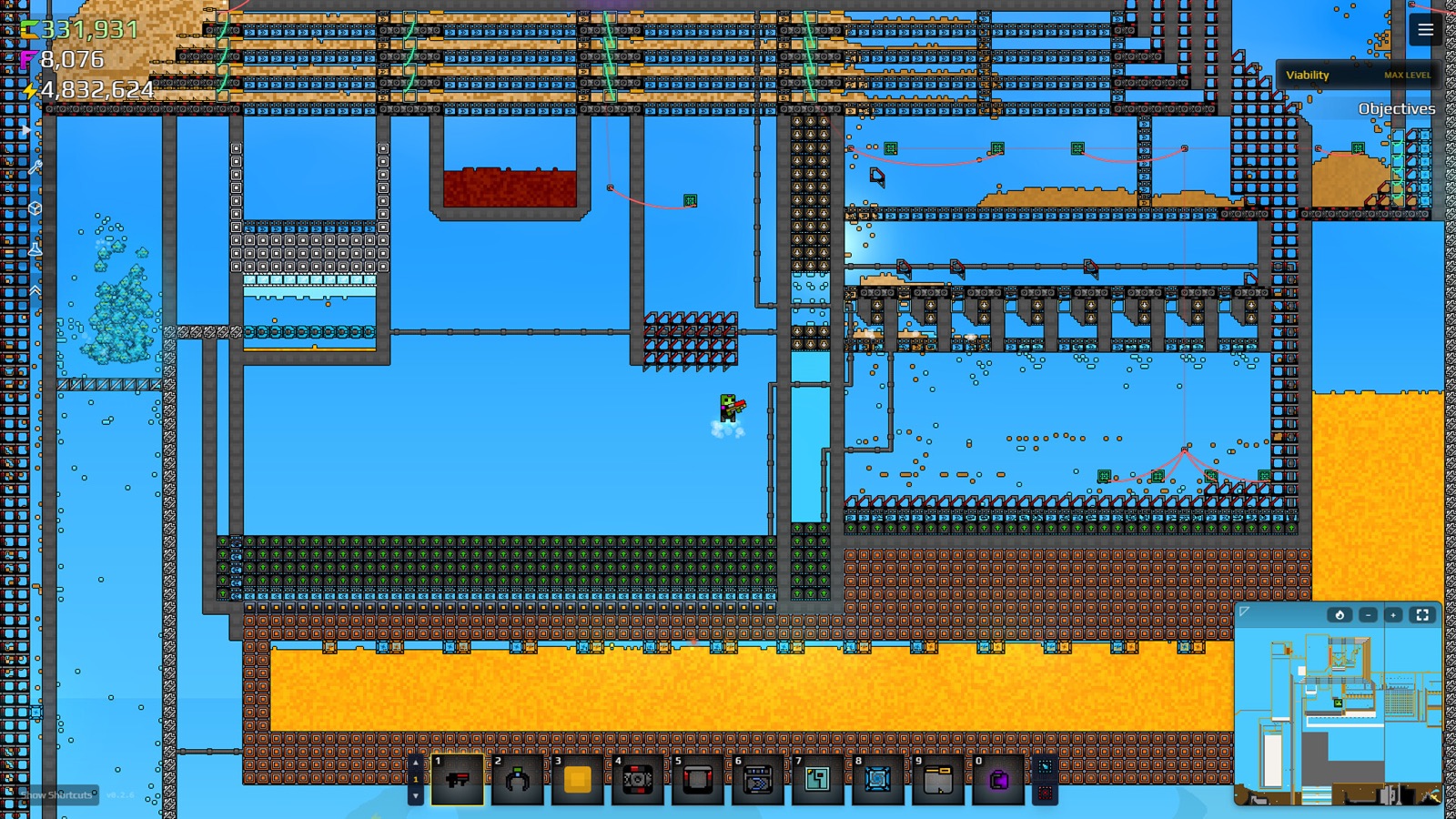
A liquid network works when a supported liquid occupies a Pump's central 2 x 2 pickup area, an unbroken Pipe connects the Pump to a Liquid Vent, and the outlet has room to release material. The visible 4 x 4 Pump footprint is misleading: solids can enter the non-solid building and block the small active region. Every Pump and Vent on one connected Pipe system shares the same network, so mixing sources also mixes what can emerge from the outlets. Lava is excluded entirely.
What you need before you build
| Requirement | Why it matters |
|---|---|
| One Pump in a clean liquid source | The source must reach the central pickup cells, not merely touch the outer edge. |
| A continuous Pipe route | Pipe can overlap blocks and may be hidden, so continuity must be checked with a Pipe-related tool equipped. |
| At least one Liquid Vent | The Vent is the endpoint that returns transported liquid to the simulation. |
| One liquid type per network | Connected sources are commingled and distributed across connected outputs. |
Step-by-step Sandustry setup
Prepare a clean intake pocket
Place the Pump inside a contained source where liquid covers its center. Add a roof or sediment barrier if Sand, Gold, or other solids can fall through the area. Because the Pump is non-solid, a foreign pixel can occupy the same space needed by the liquid.
Success check: The central cells remain liquid when inspected with the Grabber and do not collect loose solids.
Lay and verify one continuous Pipe
Connect the Pump to the intended outlet without bridging an existing fluid system. Pipes can overlap other placed blocks, which makes a segment easy to hide. Equip Pipe, Pump, Vent, or Pipe Remover when tracing the route so covered segments become visible.
Success check: The highlighted route is continuous from the intake building to the correct output building.
Place the Vent over a receiving basin
Give the Liquid Vent open space in the direction it releases liquid and contain the result before starting the Pump. A correct network can still appear broken when the outlet is buried, blocked, or immediately reacts with nearby material.
Success check: The first output remains identifiable in the receiving area instead of escaping or reacting on contact.
Test with only one source and one outlet
Commission the smallest possible network before adding branches. This isolates pickup, continuity, and outlet problems. Once flow is visible, extend to additional Vents while remembering that they all consume from the same shared connected supply.
Success check: The single Vent produces the same liquid placed at the single Pump.
Expand without connecting unlike liquids
Route Water, Liquid Gold, Florinol, and other supported liquids on physically separate Pipe systems. A network bridge does not preserve source identity. Use recognizable routes or spacing so later construction cannot accidentally join them.
Success check: Each network has one documented liquid type and no Pipe segment touches another fluid route.
Symptoms, causes, and the next check
Change one variable at a time. Start at the input and follow the material state through the line instead of rebuilding every machine at once.
| What you see | Likely cause | What to check next |
|---|---|---|
| The Vent is dry | A solid is blocking the Pump center, the Pipe is discontinuous, or the source no longer covers the pickup. | Inspect in that order: Pump contents, source level, highlighted Pipe continuity, then outlet clearance. |
| The wrong liquid appears | Two unlike sources share a connected Pipe network. | Find the bridge, remove it with the Pipe Remover, and rebuild separate routes. |
| The Pipe disappears behind a building | Pipes are allowed to overlap other blocks and can be visually hidden. | Equip a Pipe-related tool to reveal the network rather than placing a duplicate route. |
| Ordinary demolition leaves the Pipe | Pipe removal uses its dedicated tool. | Equip the Pipe Remover and target the confirmed hidden segment. |
| The Pump ignores Lava | Lava is not a supported Pump or Pipe liquid. | Cool Lava into Cinder, move the solid, and reheat it where liquid Lava is required. |
What not to do
- Do not diagnose from the visible waterline alone; inspect the Pump's active center for solids.
- Do not add branches until a one-Pump, one-Vent test succeeds.
- Do not share Pipe between liquids unless mixed output is deliberately part of a controlled process.
- Do not keep adding Pipe over a hidden break; reveal the route and remove the incorrect segment first.
Sources, confidence, and Early Access limits
This guide separates confirmed mechanics from layout recommendations. The mechanics below were checked against official Sandustry Wiki pages; layout advice is a practical way to satisfy those rules, not a claim that only one factory design works.
- Official Pump pageCentral pickup area, solid obstruction, liquid sharing, and Lava exclusion
- Official Pipe pageConnections, overlapping placement, visibility, and removal
- Official Liquid Vent pageFluid-network output role and supported connections
Sandustry is in Early Access. Recheck balance-sensitive values, research costs, and machine behavior in the current build after a game update.