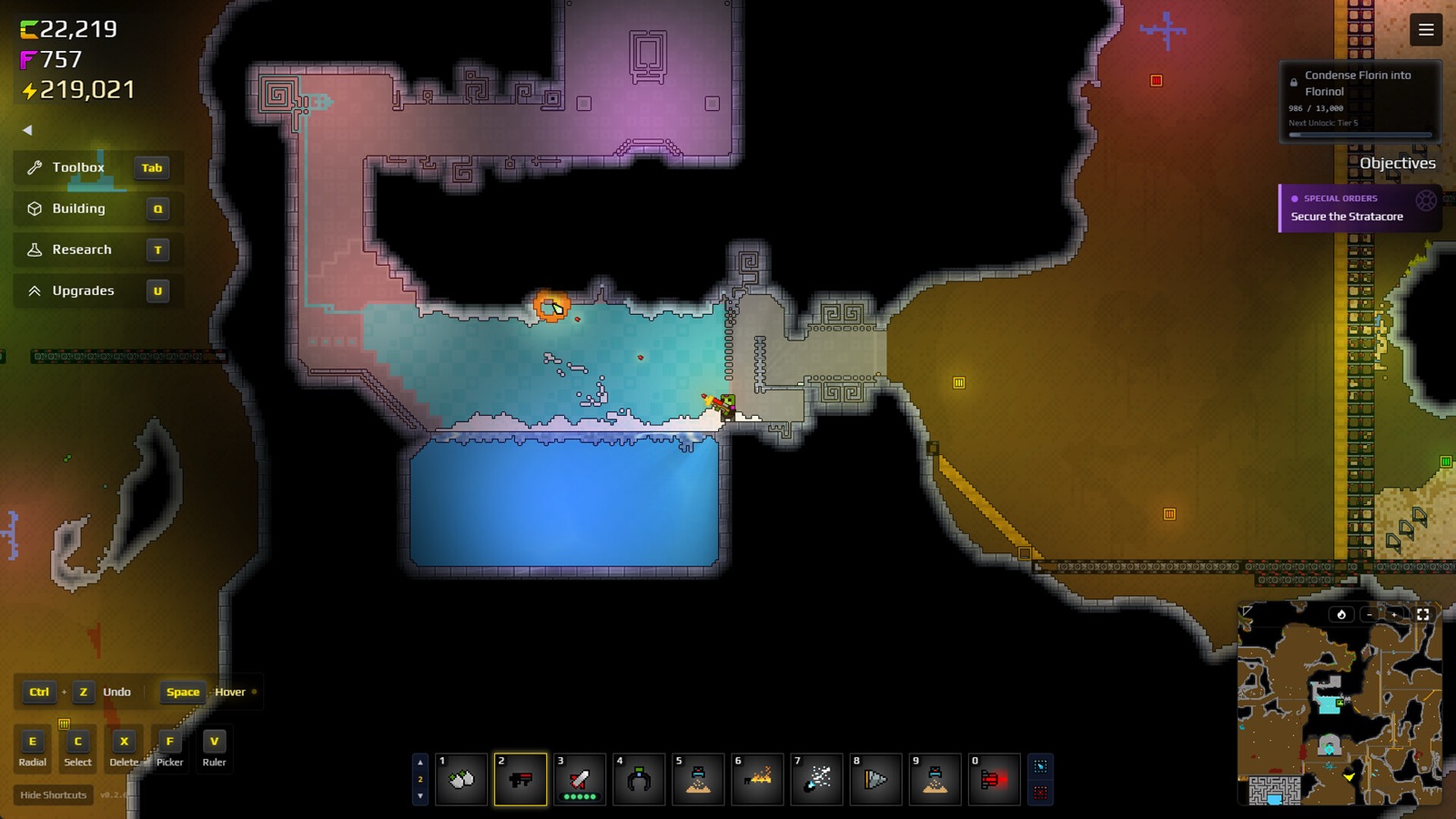
The fastest early Water source is an existing surface lake or underground deposit. Dig a contained channel from that source to the work area, or carry small amounts manually until Pumps are available. Build the reservoir before opening the route: Water spreads to a flat surface, can escape through unsealed corners, and loose droplets may disappear if they cannot settle. For the first Gold line, expose Sand to Water only at a controlled contact point because every one Sand and one Water that touch become two Wet Sand.
What you need before you build
| Requirement | Why it matters |
|---|---|
| A visible Water source | Use a lake, an underground pocket, melted Ice, or captured rain. The opening route should not depend on a late-game renewable loop. |
| A sealed depression | Water needs a low place to settle. Solid walls must overlap at corners instead of merely touching diagonally. |
| A controlled Sand inlet | Keep dry Sand away from the reservoir until the mixing point, otherwise Wet Sand forms in the supply channel. |
| Pump, Pipe, and Liquid Vent when unlocked | These move supported liquids without cutting a long open trench, but are optional for the first manual line. |
Step-by-step Sandustry setup
Survey before digging
Choose the closest Water body that sits above or level with the intended factory. A gravity-fed route is simpler to observe than a deep shaft. Keep heat-producing work away from the route so Water does not become Steam before it reaches the mixer.
Success check: You can identify one source, one reservoir location, and a downhill or pumped path between them.
Build the basin while the source is closed
Excavate a depression with a flat bottom and solid sides. Seal every diagonal corner with an additional block. Leave free capacity above the intended operating level so a new batch does not immediately overflow into machines or electrical production.
Success check: A small test amount settles inside the basin without slipping through a corner.
Open a narrow supply path
Release Water through a narrow channel rather than removing the entire wall. Watch the leading edge until it reaches the basin. If isolated droplets skim across a flat ledge, deepen that section so they can settle instead of remaining mobile long enough to evaporate.
Success check: The source fills the basin and the surface becomes level instead of scattering into isolated droplets.
Meter Water into Sand
Create a short reaction chamber beside the reservoir. Feed Sand from one side and let only a thin amount of Water reach it from the other. The confirmed reaction is one Sand plus one Water producing two Wet Sand, so an uncontrolled opening consumes both inputs wherever they first touch.
Success check: Wet Sand forms inside the chamber, while the main reservoir remains Water and the Sand feed remains dry.
Add a fluid network only when it solves distance
Place a Pump so Water occupies its central pickup area, connect a continuous Pipe, and end at a Liquid Vent over the reaction chamber. Protect the Pump from falling solids and keep this network dedicated to Water. Connected fluid networks share their inputs and outputs.
Success check: The Vent emits Water consistently and stops only when the source or the Pump pickup is empty.
Symptoms, causes, and the next check
Change one variable at a time. Start at the input and follow the material state through the line instead of rebuilding every machine at once.
| What you see | Likely cause | What to check next |
|---|---|---|
| Water disappears along the route | Droplets have no depression in which to settle, or nearby heat is turning them into Steam. | Deepen the channel, add a catch basin, then inspect for a heat source before releasing more Water. |
| The reservoir leaks at a corner | Two walls touch diagonally but do not seal the pixel gap. | Overlap the boundary with another solid block and retest with a small amount. |
| Wet Sand forms inside the supply | Dry Sand is contacting Water before the intended mixer. | Separate the two routes and remove loose Sand from the reservoir and Pump area. |
| A connected Liquid Vent is dry | The Pump's central pickup area may contain solids even though Water is visible around it. | Hover the Grabber over the Pump, clear foreign pixels, and confirm Water reaches the center. |
| Output contains another liquid | A second liquid source is connected to the same Pipe network. | Disconnect the bridge and rebuild one dedicated network per liquid. |
What not to do
- Do not open an entire lake wall before the receiving basin is sealed and tested.
- Do not run the Water supply through the Sand storage area; the reaction begins on contact, not inside a machine.
- Do not assume the full 4 x 4 Pump footprint collects liquid. Only its central 2 x 2 region is the pickup area.
- Do not connect Lava to the system. Standard Pumps and Pipes exclude Lava.
Sources, confidence, and Early Access limits
This guide separates confirmed mechanics from layout recommendations. The mechanics below were checked against official Sandustry Wiki pages; layout advice is a practical way to satisfy those rules, not a claim that only one factory design works.
- Official Water pageWater sources, evaporation, reactions, barriers, and corner leakage
- Official Pump pagePickup area, solid blockages, supported liquids, and shared networks
- Official Pipe pagePipe connections, overlapping placement, and liquid-network behavior
Sandustry is in Early Access. Recheck balance-sensitive values, research costs, and machine behavior in the current build after a game update.